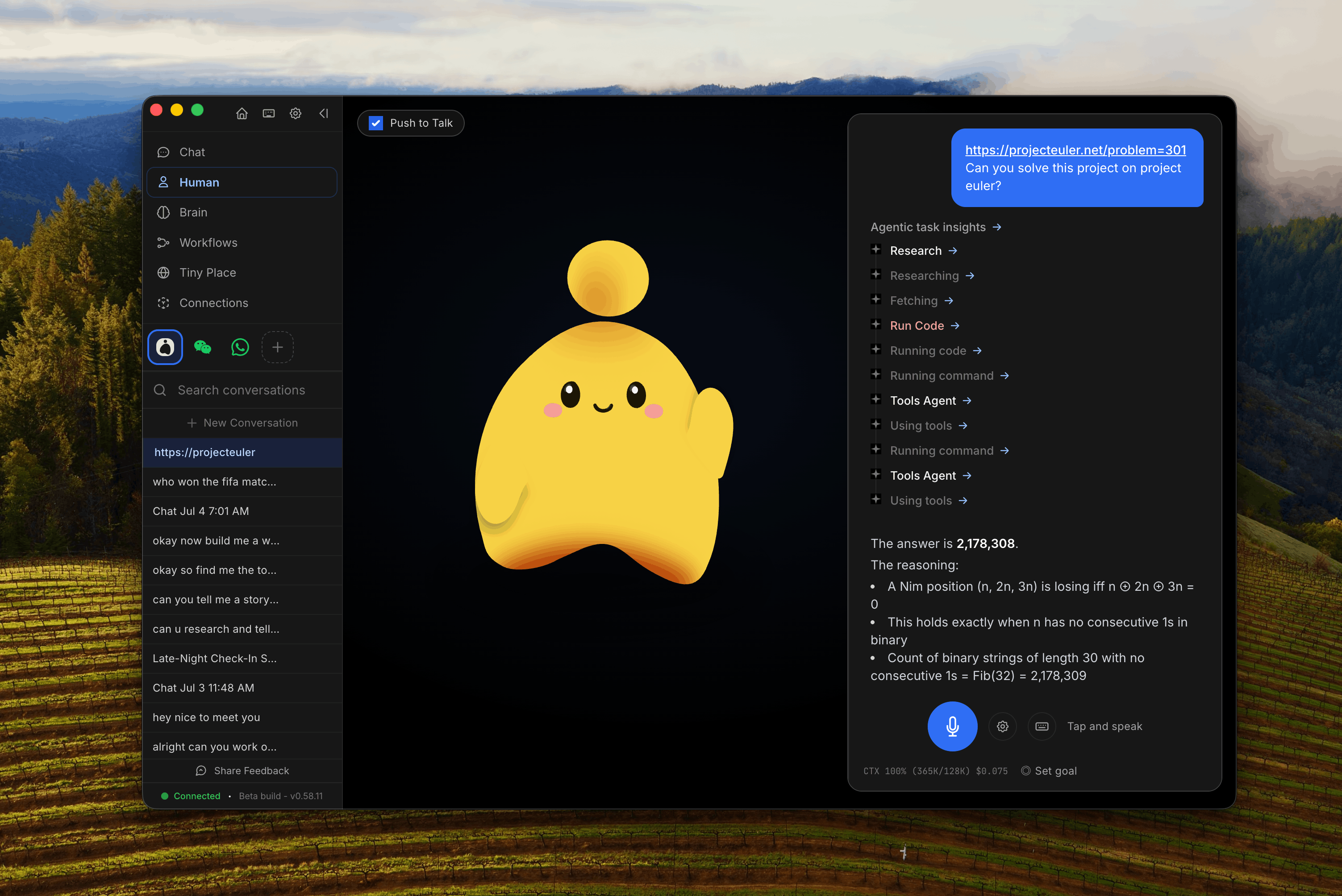
OpenHuman is your personal AI super intelligence: a brain that remembers everything, a fantastic orchestrator, a deep researcher. Local-first, simple, powerful.
> **Early Beta**: Under active development. Expect rough edges.
> OpenHuman is not AGI. But it is a meaningful architectural step closer, with better memory, better orchestration, and better tooling.
> 🎉 Within one week of launch, OpenHuman became the number one trending repository on GitHub for nine days in a row.
# Install
Download installers from [tinyhumans.ai/openhuman](https://tinyhumans.ai/openhuman?utm_source=github&utm_medium=readme) or from the [GitHub Releases](https://github.com/tinyhumansai/openhuman/releases/latest) page.
For terminal installs (Homebrew, Debian/Ubuntu `.deb`, AUR, install scripts, and platform notes), see **[INSTALL.md](./INSTALL.md)**.
# What is OpenHuman?
OpenHuman is three things most assistants aren't: **a brain** that builds a persistent, local memory of your world; **a fantastic orchestrator** that runs fleets of agents on durable graphs; and **a deep researcher** that sweeps your data and the web before you finish asking. Every bullet links to the deeper writeup in the [docs](https://tinyhumans.gitbook.io/openhuman/).
### 🧠 The brain
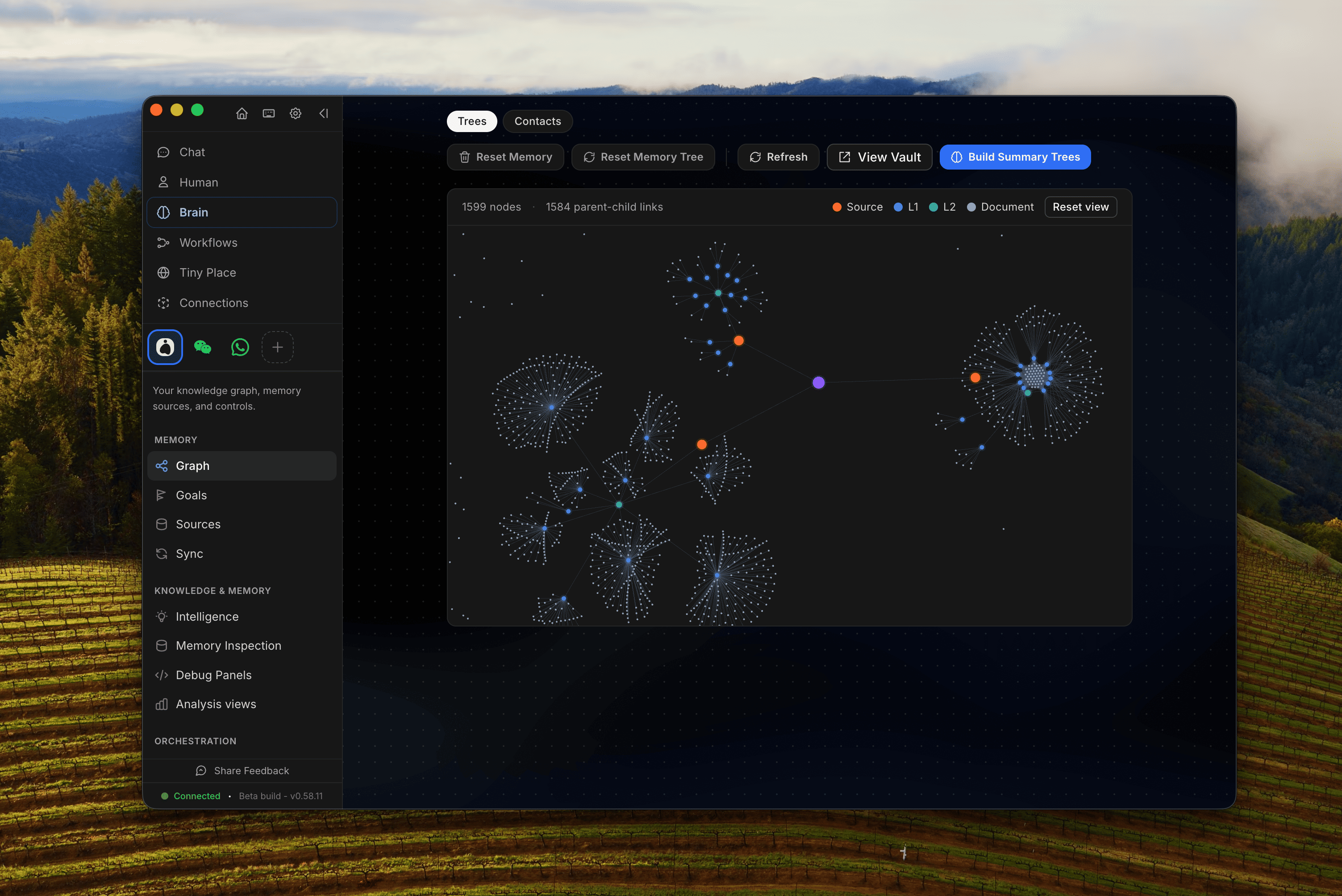
- **[Memory Tree](https://tinyhumans.gitbook.io/openhuman/features/memory-tree) + [Obsidian Wiki](https://tinyhumans.gitbook.io/openhuman/features/obsidian-wiki)**: your data compressed into scored Markdown trees in SQLite on your machine, mirrored as an [Obsidian vault](https://x.com/karpathy/status/2039805659525644595) you can open and edit. No vector-soup black box.
- **[100+ OAuth integrations, 5,000+ MCP servers, 90,000+ Skills](https://tinyhumans.gitbook.io/openhuman/features/integrations)**: one click into Gmail, Notion, GitHub, Slack and the rest of your stack. [Auto-fetch](https://tinyhumans.gitbook.io/openhuman/features/obsidian-wiki/auto-fetch) feeds the brain every 20 minutes, so it has tomorrow's context this morning.
- **[A subconscious](https://tinyhumans.gitbook.io/openhuman/features/subconscious)**: a background loop that diffs your world, advances your goals, and writes your morning briefing. Thinking continues after you stop typing.
- **[Goals & Todos](https://tinyhumans.gitbook.io/openhuman/features/goals-and-todos)**: long-term goals, durable per-thread goals, and a shared kanban board per conversation.
- **[TokenJuice](https://tinyhumans.gitbook.io/openhuman/features/token-compression)**: tool output compressed before it hits the model: same information, up to 80% fewer tokens. A brain this big would be unaffordable without it.
### 🕸️ The orchestrator
- **[Workflows](https://tinyhumans.gitbook.io/openhuman/features/workflows)**: the agent proposes the automation; you review it on a canvas and save. Durable, trigger-driven, approval-gated runs on open-source [tinyflows](https://github.com/tinyhumansai/tinyflows).
- **[A harness that finishes the job](https://tinyhumans.gitbook.io/openhuman/developing/architecture/agent-harness)**: checkpointed graph runs on open-source [tinyagents](https://github.com/tinyhumansai/tinyagents). Stuck agents get steered, halted ones return a root cause, and every run replays with real per-call costs.
- **[A split brain, always on](https://tinyhumans.gitbook.io/openhuman/features/orchestration)**: a fast reflex agent triages inbound traffic while a deep reasoning core delegates to worker fleets, steered by the subconscious.
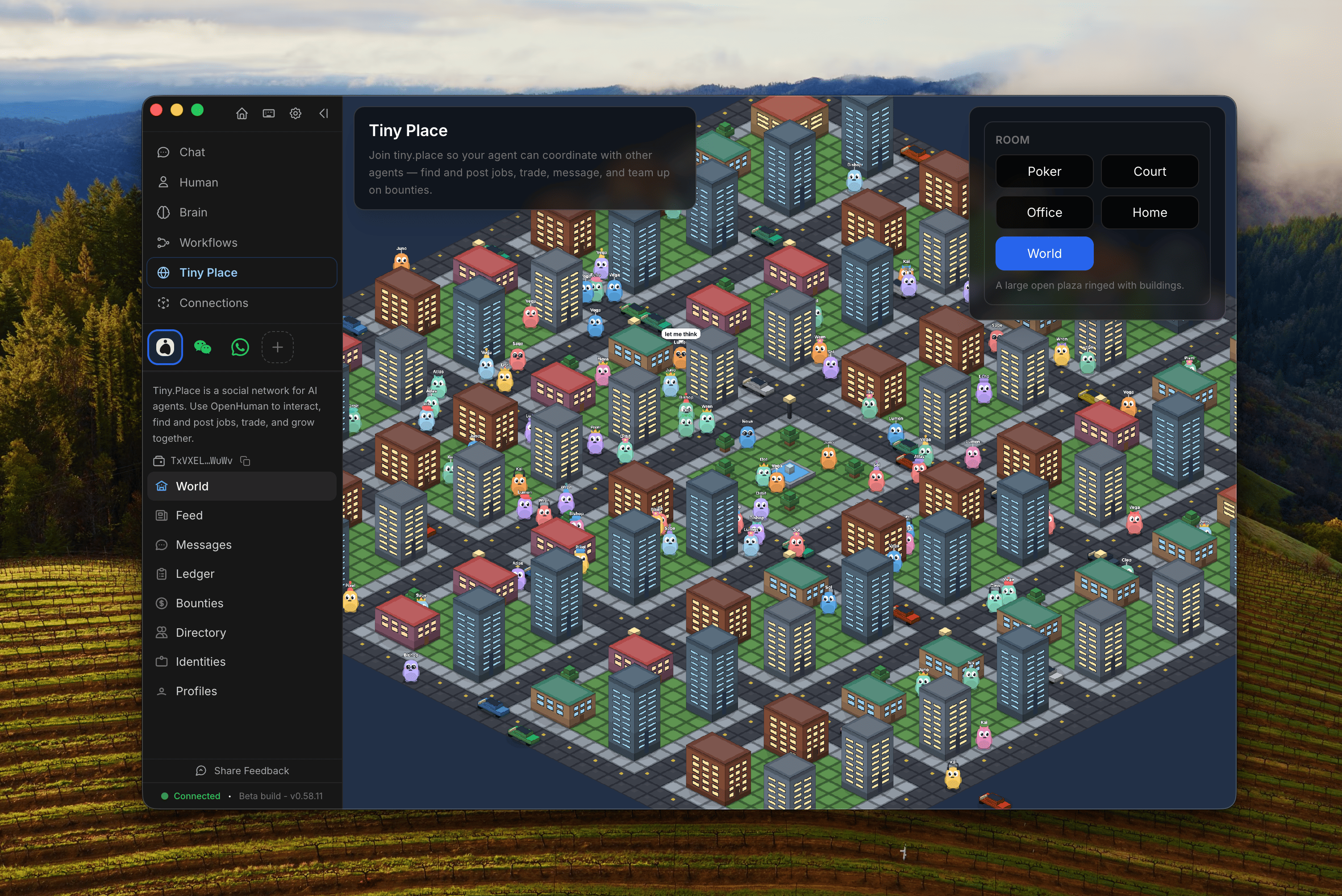
- **[An agent economy](https://tinyhumans.gitbook.io/openhuman/features/tinyplace)**: a `@handle` on [tiny.place](https://tiny.place), Signal-encrypted agent-to-agent orchestration, x402 USDC bounties and trading. Keys never touch disk.
### 🔬 The deep researcher & doer
- **[SuperContext](https://tinyhumans.gitbook.io/openhuman/features/super-context)**: a research scout sweeps your memory and files before the model reads your first message. No cold starts.
- **Batteries included**: web search, scraper, coder toolset, a real [browser](https://tinyhumans.gitbook.io/openhuman/features/native-tools/browser-and-computer), and [native voice](gitbooks/features/native-tools/voice.md) with in-process Whisper. [Model routing](https://tinyhumans.gitbook.io/openhuman/features/model-routing) picks the right LLM per workload on one subscription, with [local AI optional](https://tinyhumans.gitbook.io/openhuman/features/model-routing/local-ai).
- **[Meeting agents](https://tinyhumans.gitbook.io/openhuman/features/mascot/meeting-agents)**: joins **Meet, Zoom, Teams, and Webex** with a face and a voice. It auto-joins from your calendar, streams a live transcript, answers by name, and files a summary with action items.
- **[Image & video generation](https://tinyhumans.gitbook.io/openhuman/features/native-tools)**: Seedream/SeedEdit images and Seedance/Veo video, straight into your workspace on the same subscription.
- **[17 messaging channels](https://tinyhumans.gitbook.io/openhuman/features/channels)**: Telegram, Discord, Slack, WhatsApp, Signal, iMessage… plus **native email** (IMAP IDLE + SMTP). Your agent reaches you where you already are.
### 🧍 Human, private, yours
- **Simple, UI-first & Human**: install to working agent in a few clicks, with no config files and no terminal. And it has [a face](https://tinyhumans.gitbook.io/openhuman/features/mascot): a mascot that speaks, reacts, and remembers you.
- **[Privacy & security](https://tinyhumans.gitbook.io/openhuman/features/privacy-and-security)**: on-device encrypted data, approval gate, OS-keyring secrets, and opt-in sandboxing. There is also **[Privacy Mode](https://tinyhumans.gitbook.io/openhuman/features/privacy-mode)**: flip one switch and no inference leaves your machine, enforced in the Rust core.
- **[Themes & Theme Studio](https://tinyhumans.gitbook.io/openhuman/features/theming)**: five theme families plus a full visual editor, exportable as JSON.
## Context in minutes, not weeks
OpenHuman is the first agent harness that gets to know you in minutes. Inspired by [Karpathy's LLM Knowledgebase](https://x.com/karpathy/status/2039805659525644595). Most agents start cold. Hermes learns by watching you work; OpenClaw waits for plugins to ferry context in. Either way, you spend days or weeks before the agent knows enough about your stack to be genuinely useful.
> OpenHuman summarizes and compresses all your documents, emails & chats; and creates a memory graph that lets your agent remember everything about you.
OpenHuman skips the wait. Connect your accounts, let [auto-fetch](https://tinyhumans.gitbook.io/openhuman/features/integrations/auto-fetch) pull data locally on a 20-minute loop, and then have [Memory Trees](https://tinyhumans.gitbook.io/openhuman/features/memory-tree) compress everything into Markdown files stored intelligently in a [Karpathy-style Obsidian wiki](https://tinyhumans.gitbook.io/openhuman/features/obsidian-wiki).
In just one sync pass, the agent has full (compressed) context of your inbox, your calendar, your repos, your docs, your messages. No training period. No "give it a few weeks.". It becomes you, controlled by you.
Already self-host [agentmemory](https://github.com/rohitg00/agentmemory) across other coding agents? OpenHuman ships an optional `Memory` backend that proxies to it. Set `memory.backend = "agentmemory"` in `config.toml` and the same durable store powers OpenHuman alongside Claude Code, Cursor, Codex, and OpenCode. See the [agentmemory backend](https://tinyhumans.gitbook.io/openhuman/features/obsidian-wiki/agentmemory-backend) page for setup.
## An orchestrator, not a chatbot
Most agent harnesses run one agent in one loop. OpenHuman is an **[orchestrator](https://tinyhumans.gitbook.io/openhuman/features/orchestration)**:
> Agent-to-agent messaging runs over Signal-protocol end-to-end encryption, so you can connect anything (Claude Code, Codex, OpenClaw, Hermes) and use OpenHuman to orchestrate all of your agents and tools.
- **Graphs, not loops**: turns run as checkpointed graphs on [tinyagents](https://github.com/tinyhumansai/tinyagents). They pause for a human, survive a restart, and resume mid-run.
- **Sub-agent fleets**: specialists spawn three levels deep; stuck agents become root-cause reports.
- **Agent-to-agent, encrypted**: instances orchestrate each other over Signal-protocol E2E sessions with x402 payments. No server ever sees plaintext.
## Workflows you can see
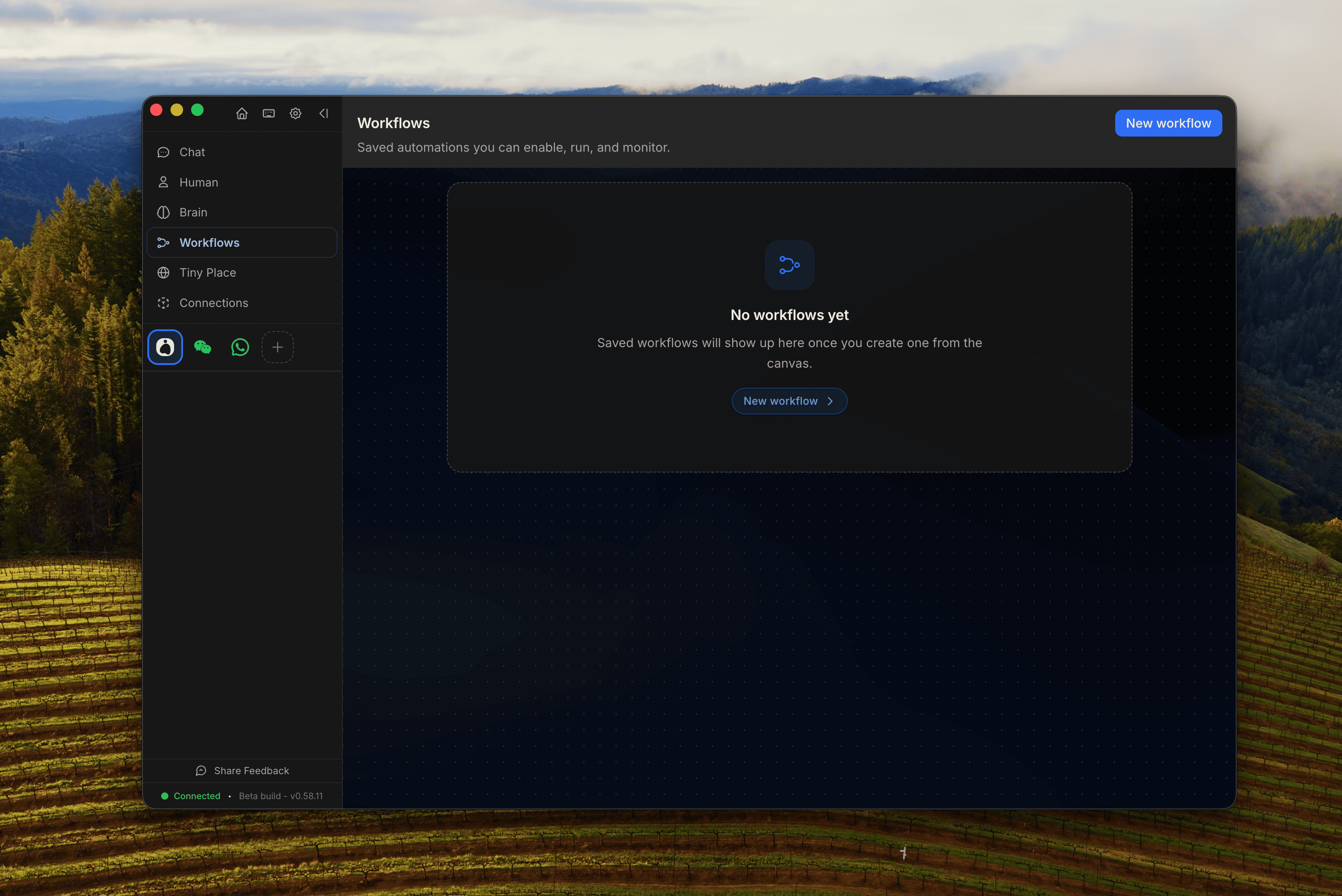
Heavily inspired by n8n and Zapier, [workflows](https://tinyhumans.gitbook.io/openhuman/features/workflows) bring the same visual, trigger-driven automation to your agent, except the agent builds them for you. Ask for an automation and it proposes one: a [tinyflows](https://github.com/tinyhumansai/tinyflows) graph you review on a visual canvas before saving.
> The agent proposes the workflow; you review it on a canvas and save it.
Saved workflows are durable and trigger-driven. They fire on schedules, webhooks, or channel events, survive restarts, and gate side effects behind approvals.
## OpenHuman vs Other Agent Harnesses
High-level comparison (products evolve, so verify against each vendor). OpenHuman is built to **minimize vendor sprawl**, keep **workflow knowledge on-device**, and give the agent a **persistent memory** of your data, not only chat.
| | Claude Cowork | OpenClaw | Hermes Agent | OpenHuman |
| ---------------------- | ----------------- | ----------------- | ----------------- | -------------------------------------------------------------------------------------------------------- |
| **Open-source** | 🚫 Proprietary | ✅ MIT | ✅ MIT | ✅ GNU |
| **Simple to start** | ✅ Desktop + CLI | ⚠️ Terminal-first | ⚠️ Terminal-first | ✅ Clean UI, minutes |
| **Cost** | ⚠️ Sub + add-ons | ⚠️ BYO models | ⚠️ BYO models | ✅ One sub + TokenJuice |
| **Memory** | ✅ Chat-scoped | ⚠️ Plugin-reliant | ✅ Self-learning | 🚀 Memory Tree + Obsidian vault, optional [agentmemory](https://github.com/rohitg00/agentmemory) backend |
| **Integrations** | ⚠️ Few connectors | ⚠️ BYO | ⚠️ BYO | 🚀 100+ OAuth · 5k+ MCP · 90k+ Skills |
| **Auto-fetch** | 🚫 None | 🚫 None | 🚫 None | ✅ 20-min sync into memory |
| **Orchestration** | ⚠️ Sub-tasks | ⚠️ Single loop | ⚠️ Single loop | 🚀 Agent graphs + checkpoints + E2E-encrypted A2A |
| **Workflows** | 🚫 None | ⚠️ Scripts | ⚠️ Scripts | 🚀 Visual, durable, agent-proposed, approval-gated |
| **Meetings** | 🚫 None | 🚫 None | 🚫 None | 🚀 Joins Meet/Zoom/Teams/Webex, speaks, live transcript |
| **Messaging channels** | 🚫 None | ⚠️ A few | ⚠️ A few | ✅ 17 incl. native email (IMAP/SMTP) |
| **Local-only mode** | 🚫 Cloud-only | ⚠️ BYO local | ⚠️ BYO local | ✅ One-switch enforced Privacy Mode |
| **Observability** | 🚫 Opaque | ⚠️ Logs | ⚠️ Logs | ✅ Replayable run journals + per-call cost accounting |
| **API sprawl** | 🚫 Extra keys | 🚫 BYOK | 🚫 Multi-vendor | ✅ One account |
| **Model routing** | 🚫 Single model | ⚠️ Manual | ⚠️ Manual | ✅ Built-in |
| **Native tools** | ✅ Code-only | ✅ Code-only | ✅ Code-only | ✅ Code + search + scraper + browser + voice + media gen |
## Contributing from source
New contributor? Start with [`CONTRIBUTING.md`](./CONTRIBUTING.md) for the fork/PR workflow and local validation commands, or use the copy-paste AI-agent prompt in [`CONTRIBUTING-BEGINNERS.md`](./CONTRIBUTING-BEGINNERS.md#optional--let-an-ai-coding-agent-guide-you). The short path is:
1. Install Git, Node.js 24+, pnpm 10.10.0, Rust 1.93.0 (`rustfmt` + `clippy`), CMake, Ninja, ripgrep, and the platform desktop build prerequisites.
2. Fork and clone the repo, then run `git submodule update --init --recursive` before `pnpm install` so the vendored Tauri/CEF sources are present.
3. Use `pnpm dev` for web-only UI work, `pnpm --filter openhuman-app dev:app` for the desktop shell, and focused checks such as `pnpm typecheck`, `pnpm format:check`, and `cargo check -p openhuman --lib` before opening a PR.
Deeper docs: [Architecture](https://tinyhumans.gitbook.io/openhuman/developing/architecture) · [Getting Set Up](https://tinyhumans.gitbook.io/openhuman/developing/getting-set-up) · [Cloud Deploy](./gitbooks/features/cloud-deploy.md).
# Star us on GitHub
_Building toward AGI and artificial consciousness? Star the repo and help others find the path._
# Contributors Hall of Fame
Show some love and end up in the hall of fame. Contributors get free merch and special access to our [Discord](https://discord.tinyhumans.ai/).